A healthy acoustic environment
When someone laughs or slams a desk, vibrations travel through the air. These vibrations are what’s known as sound waves. These sound waves may be just background noises to you, but to someone else they may be unwanted noises that disturbs their quiet working conditions.
In schools and preschools, it’s not uncommon to have an average noise level of 70 decibels. Once the level gets above 40 decibels, which is roughly the level during a normal conversation, this reduces the working capacity and negatively affects learning conditions for students. A poor acoustic environment requires individuals to use more of their working memory to hear and interpret what the teacher is saying instead of focusing on the actual message. This results in tiredness and lack of concentration, among other things.
Investing in the acoustic environment is worthwhile for both teachers and students. It is in fact a necessity for students with hearing or reading and writing difficulties, for those who are non-native speakers and definitely for students with concentration problem.
Three steps to reviewing and achieving a comfortable noise level:
Think about the ceiling. More often than not, this is the most important surface to consider if you want to achieve a comfortable noise level. If there is a wall-to-wall suspended ceiling, it’s essential that the absorbent panels are at least 40 mm thick. If there is no suspended ceiling, individual absorbent panels can be installed to counter the spread of sound waves.
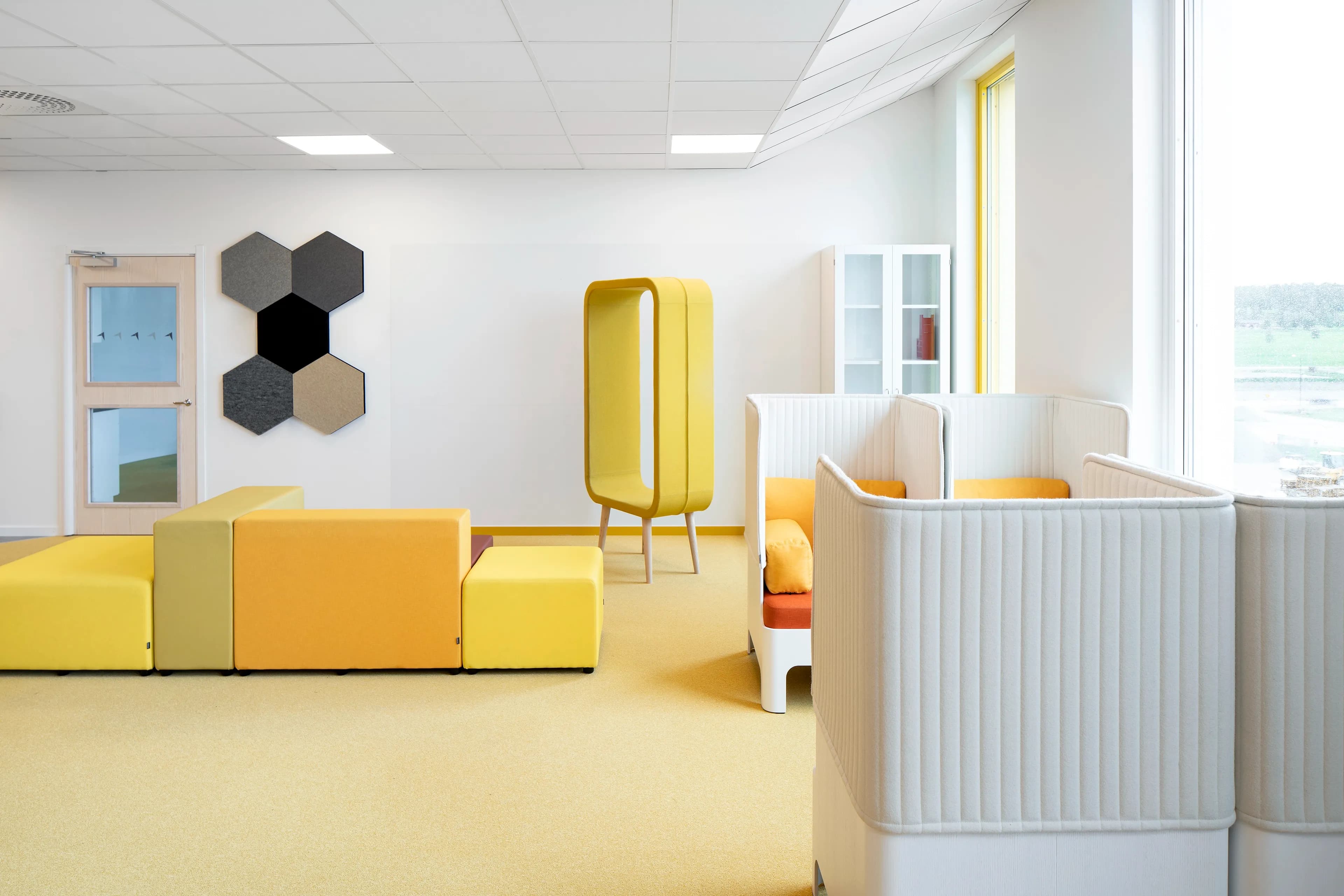
Hard wall surfaces reflect and amplify the noise level in a room. Acoustic wall panels can be used to reduce reverberation time in a room. They provide a more muted and comfortable acoustic environment.
Using screens to reduce the spread of noise between different student workspaces and learning environments is a good solution. There are several useful options here, such as desk and floor screens, suspended partitions, plants, room-within-room solutions or sofas and easy chairs with high backs and integrated absorption functions to provide seclusion.
Acoustic solutions

Input interior for school and education
Input interior is the Nordic region's leading independent interior design group with unique expertise in customised solutions for schools and education.
Read more about us at inputinterior.noMy account
ProfileProjectsOrdersAgreementsTeamCookie settings
General
Input for educationInspirationSustainabilityAbout Input InteriörFAQContact usMarket
Follow us

